Adobe
The business can grow. Your slice can grow faster.
Adobe's story has two engines: subscriptions that generate cash, and buybacks that can spread the business across fewer shares. AI tests the first. The price paid and employee stock dilution decide the second.
In the systemStorefront softwareCannibals portfolioWhere it sits ↓
Model updated on
NOTES & UPDATES
My latest thinking.
What happened. What it means.
What we’re watching next.
Latest note Q3 FY2026 earningsStill growing. Still buying back shares. Thesis intact
My take
The original buying thesis is still playing out: Adobe is growing, generating cash and buying back stock. Q3 supports keeping that thesis intact. Margins softened, so this is evidence of resilience—not a declaration that the AI threat is over.
The evidence · earnings reported
- The subscriptions are still growing.
Revenue was $6.76bn, up 13% year over year (12% in constant currency). Creative & Marketing subscriptions grew 13%; Business & Consumer grew 16%. These figures include acquisitions. [1][2]
- Cash is funding the repurchases.
Operating cash flow of $2.523bn less $85m of capital spending gives $2.438bn in free cash flow, before stock-compensation adjustments. Cash spent on repurchases: $2.232bn. [1]
- The smaller share count is doing its job.
Quarterly diluted weighted-average shares fell 6.7%, from 424.1m to 395.5m. Net income grew about 3%; diluted EPS grew about 11%. Fewer shares amplified per-share earnings. [2][1]
- Margins are the yellow flag.
GAAP operating margin fell from 36.3% to 34.8%, calculated from reported figures. Revenue growth still needs to translate into durable cash generation. [1]
Model unchanged
Q3 guidance and buybacks were already incorporated on September 12. We reviewed the September 22 filing and kept the operating assumptions and dated quote. No valuation increase. Explore the model
Watch next
- Does subscription growth keep converting into cash after investment and employee equity pay?
- Do repurchases keep reducing the net share count at sensible prices?
THE STORY IN PICTURES
AI can change the product. Buybacks change your slice.
Read the workflow threat first, then the cash and share-count math.
 Enlarge graphic
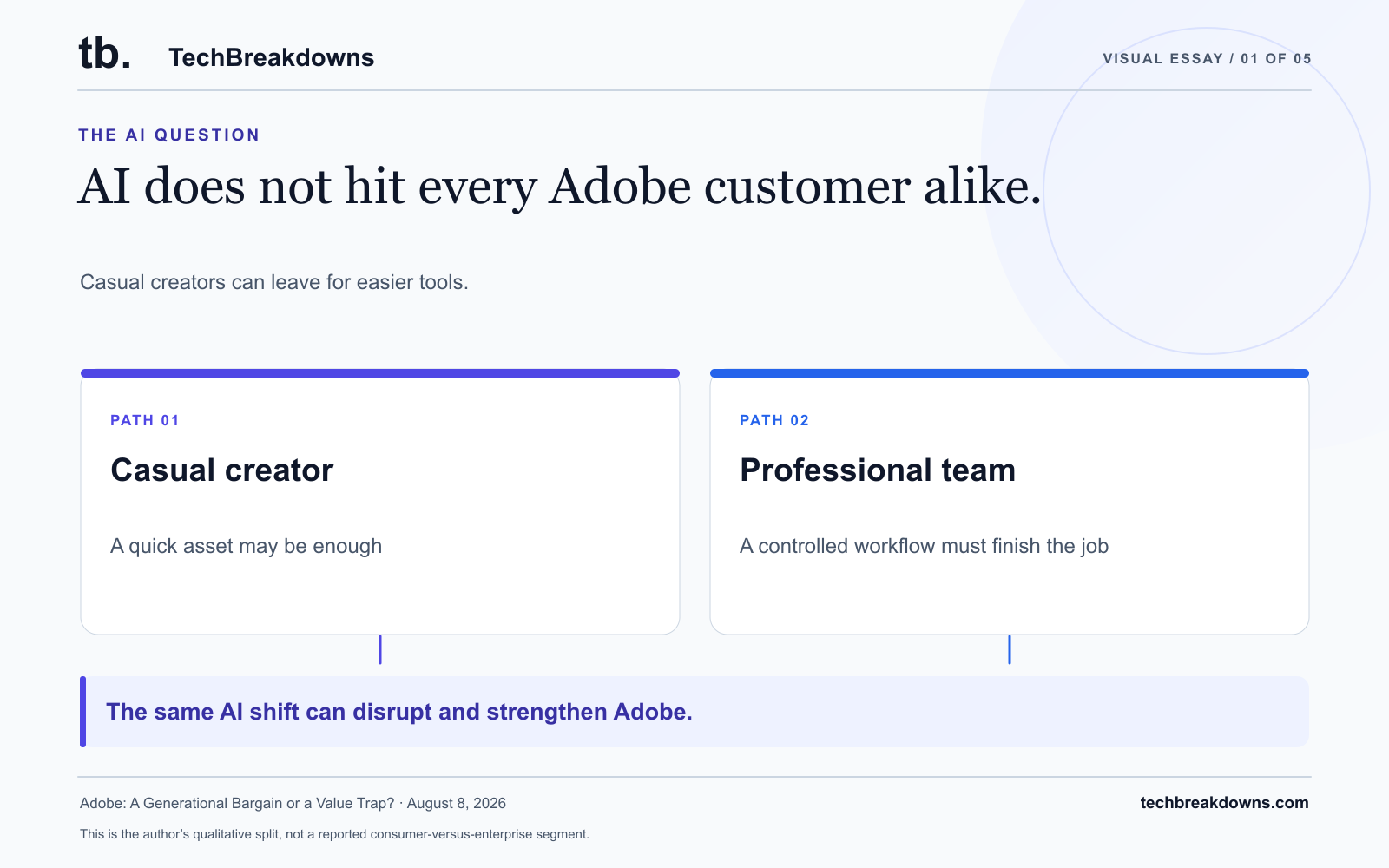
THE AI QUESTION
AI does not hit every Adobe customer alike.
Casual creators can leave for easier tools. Professionals and enterprises still need editing, collaboration, documents and controls around a finished asset.
This is the author’s qualitative split, not a reported consumer-versus-enterprise segment.
Adobe: A Generational Bargain or a Value Trap? · August 8, 2026
 Enlarge graphic
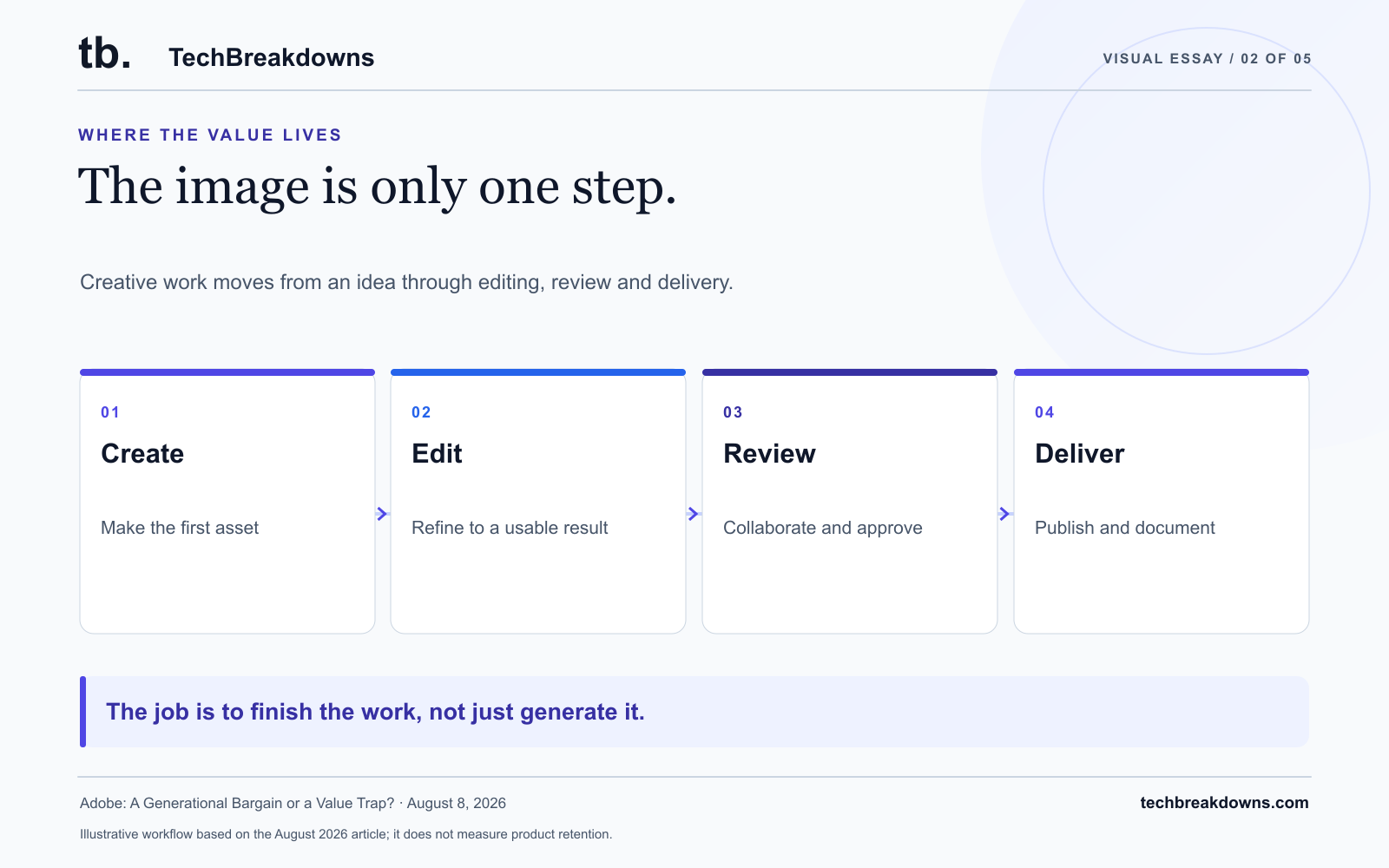
WHERE THE VALUE LIVES
The image is only one step.
Creative work moves from an idea through editing, review and delivery. Adobe’s defense rests on being useful across that longer professional workflow.
Illustrative workflow based on the August 2026 article; it does not measure product retention.
Adobe: A Generational Bargain or a Value Trap? · August 8, 2026
 Enlarge graphic
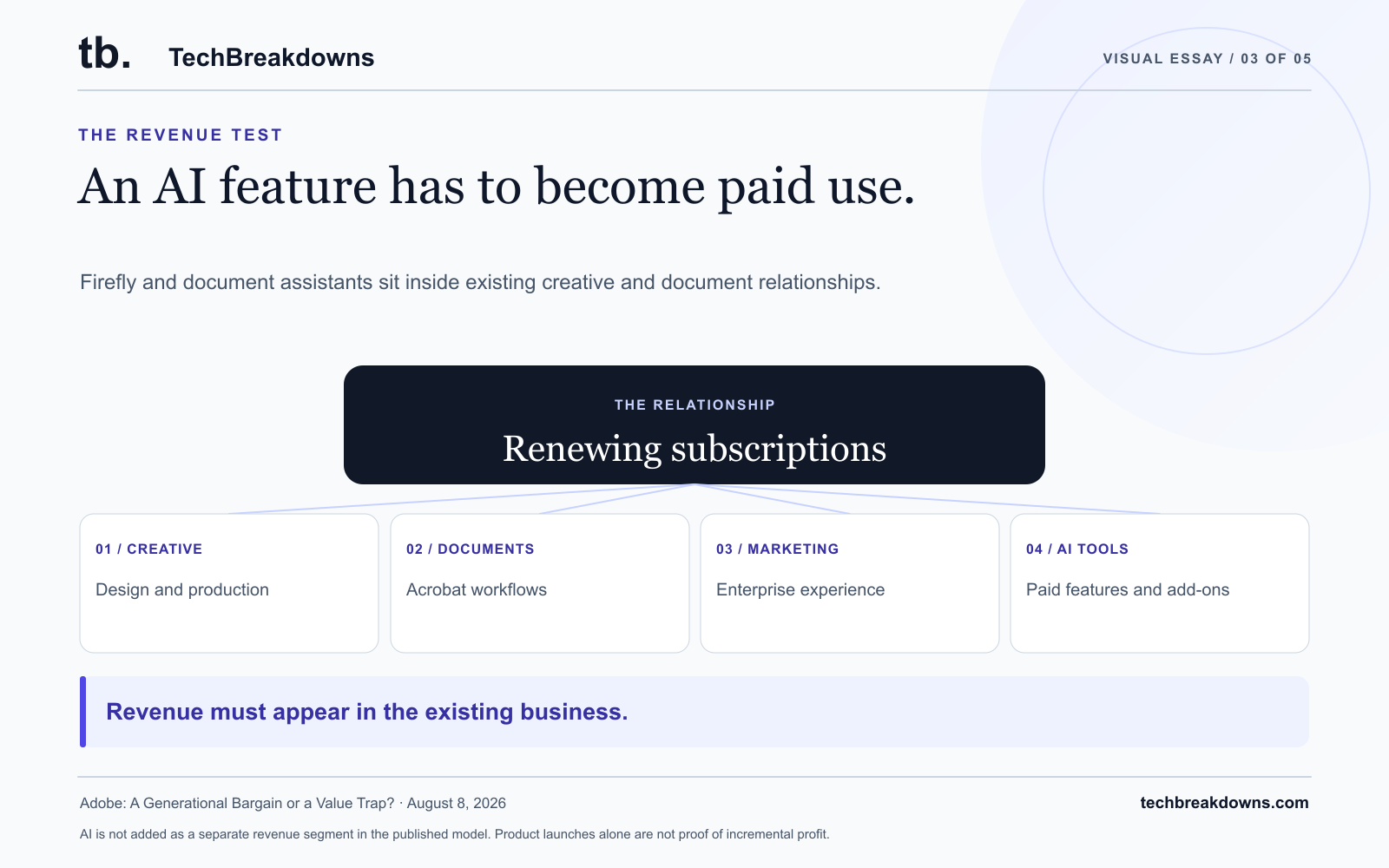
THE REVENUE TEST
An AI feature has to become paid use.
Firefly and document assistants sit inside existing creative and document relationships. AI adoption matters when it supports subscriptions and cash margins.
AI is not added as a separate revenue segment in the published model. Product launches alone are not proof of incremental profit.
Adobe: A Generational Bargain or a Value Trap? · August 8, 2026
 Enlarge graphic
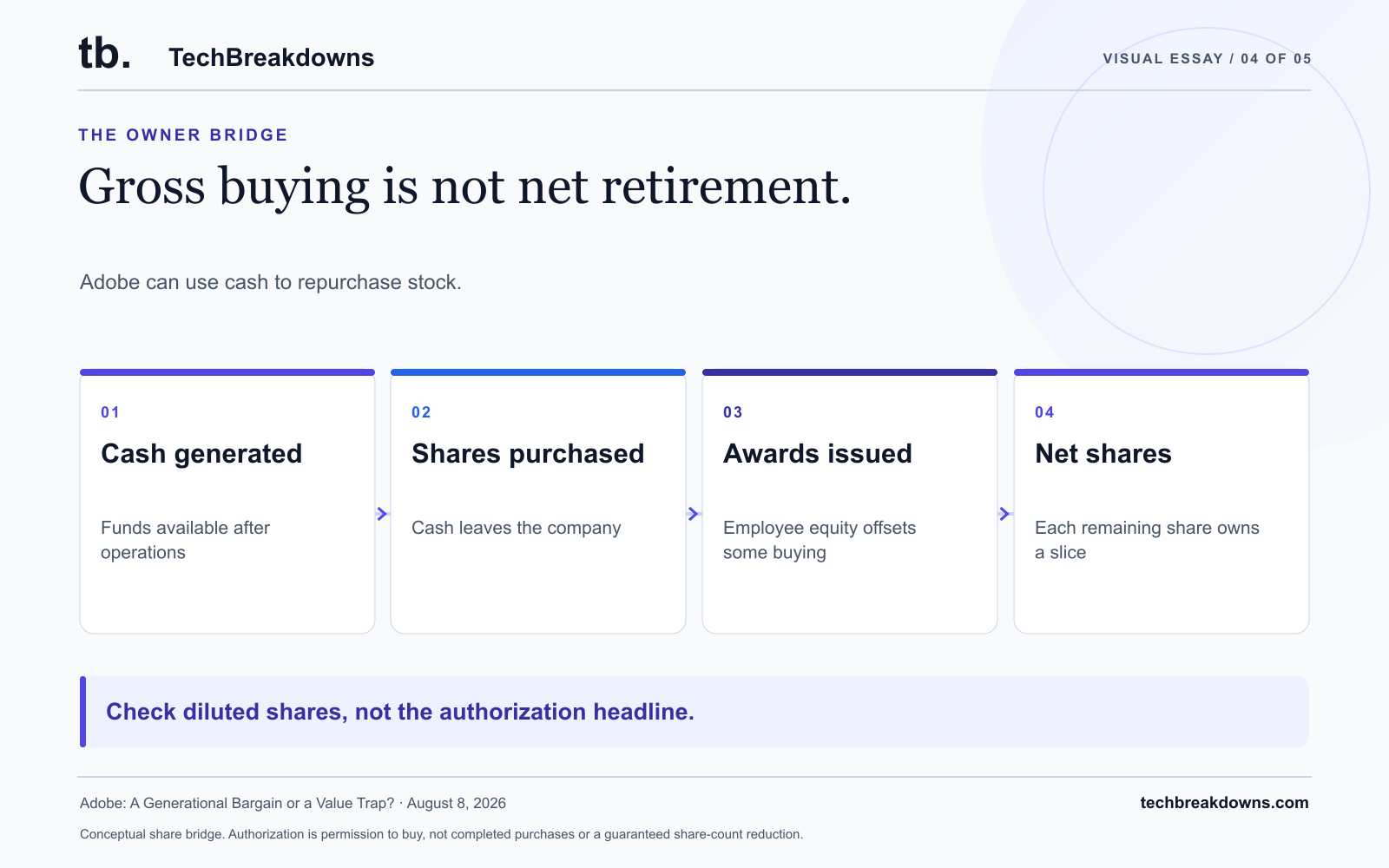
THE OWNER BRIDGE
Gross buying is not net retirement.
Adobe can use cash to repurchase stock. Employee awards create shares, and the price paid for repurchases determines how much ownership each dollar buys.
Conceptual share bridge. Authorization is permission to buy, not completed purchases or a guaranteed share-count reduction.
Adobe: A Generational Bargain or a Value Trap? · August 8, 2026
 Enlarge graphic
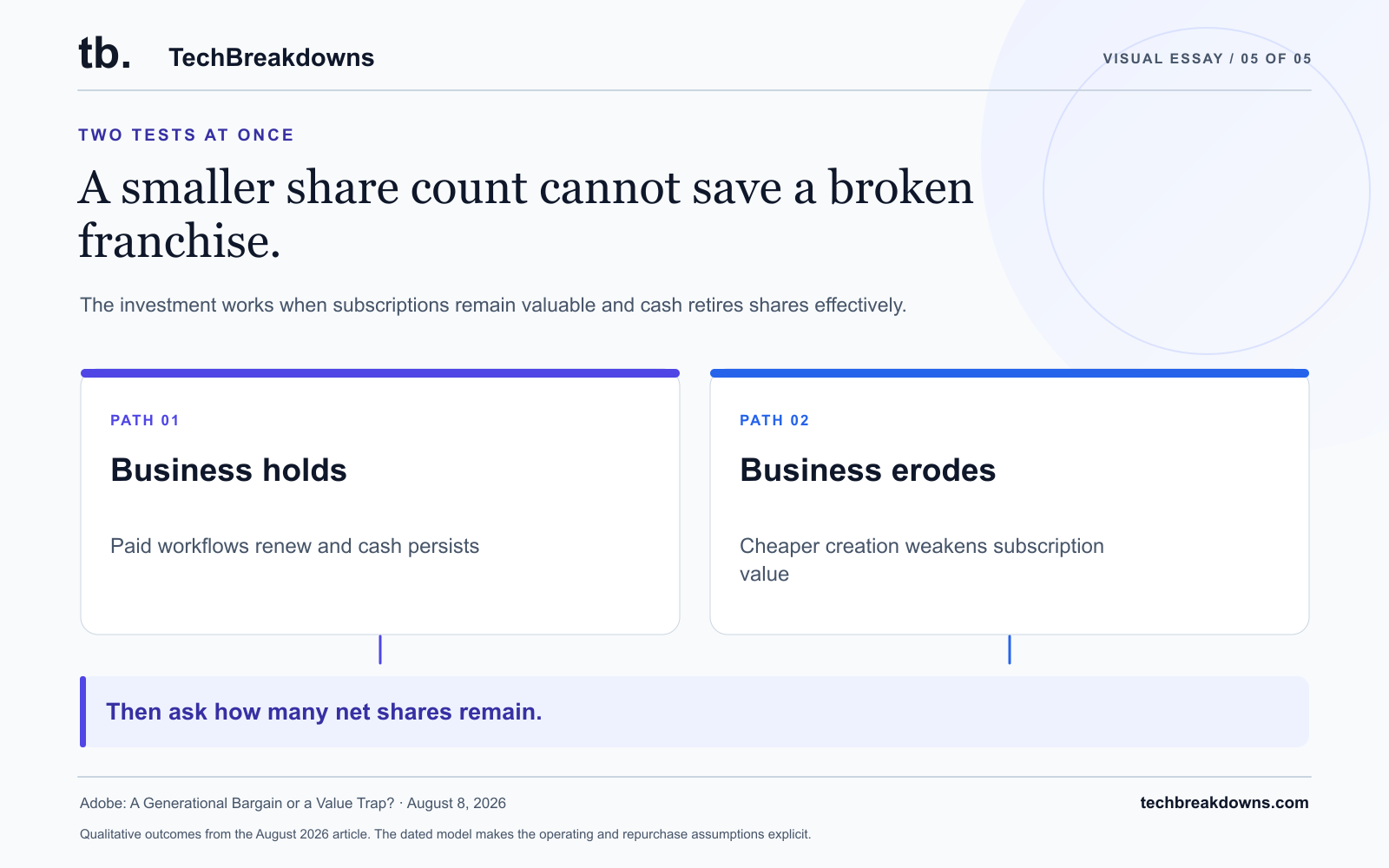
TWO TESTS AT ONCE
A smaller share count cannot save a broken franchise.
The investment works when subscriptions remain valuable and cash retires shares effectively. AI disruption can overwhelm even disciplined repurchases.
Qualitative outcomes from the August 2026 article. The dated model makes the operating and repurchase assumptions explicit.
Adobe: A Generational Bargain or a Value Trap? · August 8, 2026
The thesis in a minute
THE OVERVIEW
First, understand
the business.
The idea, the advantage,
and the question that matters.
You do not need Adobe to become a much bigger company to own more of it. When cash buys back stock faster than employee pay creates new shares, each remaining share owns a larger slice. The question is whether Adobe can keep its workflows valuable, generate cash and retire shares at attractive prices.
What it does
Adobe sells subscriptions for creative work, documents and marketing. Its customer groups span Business Professionals & Consumers and Creative & Marketing Professionals. AI tools sit inside those relationships, so paid AI adoption must show up in their revenue and margins rather than being counted again as a separate business.
Why it might win
Adobe's case rests on professional workflows that extend beyond generating an asset. Editing, collaboration, document handling and enterprise controls can give customers reasons to stay. The research argues that AI can strengthen those workflows, even while cheaper tools compete for simpler jobs.
What could break
The same technology can improve Adobe's products and reduce the need for them. Strong cash generation can fund repurchases, but a smaller share count cannot rescue a permanently shrinking franchise. Watch the operating business and the net share count together.
01 / THE STORY
Follow the business before the stock.
Can Adobe keep professional workflows valuable enough that AI and buybacks both benefit owners?

The first draft gets cheaper
Casual creative jobs face new alternatives. That is a credible pressure on Adobe's reach, but it does not settle what professional customers will pay for an entire workflow.

The workflow has to earn its seat
The bull case requires AI to make Adobe's subscriptions more useful and valuable. The bear case has competitors taking enough work away to pressure growth and cash margins.

Then follow the share count
The model uses the remaining repurchase authorization and also issues shares for compensation. Owners benefit from the net result. The price paid for each repurchase matters alongside the business performance.
Who pays, and why?
Creative professionals
Subscribe to tools for making, editing and finishing assets.
Businesses and consumers
Pay for document, productivity and creative workflows.
Marketing teams
Buy tools to create, manage and measure customer experiences.
Find the revenue engine.
Each business has a different path from customer activity to value per share. These are the levers used in the model.
Business & consumer subscriptions
Document and productivity work can sustain a recurring relationship.
Creative & marketing subscriptions
Creative and campaign workflows must earn renewal as AI alternatives spread.
Firefly and AI features
Paid AI adoption is captured inside the subscription groups, avoiding a second count of revenue.
Cash and repurchases
The number of shares retired after employee issuance determines how much cash flow each share owns.
AI is discussed as a product and monetization driver, not a separately added model segment. See dated sources
THE OWNERSHIP STORY
Follow the share count.
A business can grow.
Your share of it can change, too.
MODELED SHARES OUTSTANDING
DO THE BUYBACKS ADD VALUE?
Same business assumptions. The no-buyback case keeps the unspent cash.
Test the buyback assumptions
THE BUSINESS
How the story becomes a business.
Keep the workflow
Creative, document and marketing customers renew subscriptions because the tools help them finish useful work.
Make AI pay
Paid adoption must lift customer-group revenue or cash margins within the existing business.
Grow the owner's slice
Cash-funded repurchases compete with compensation dilution; the remaining share count shapes value per share.
Loading reported business flow…
THE VALUATION MODEL
One business.
Three possible futures.
The business is the same. The assumptions change.
Choose a case, then make it your own.
Each number is a modeled ending, not a reported result.
What needs to happen?
Change the main drivers here. Then view the money flow or open the full model below.
Explore the other businesses
Give each business its own growth and cash margin. Every change flows into this same scenario.
Reference price —
SEE THE MODEL IN MOTION
See where the money goes.
The sliders above shape one scenario. Follow its annual money flow below, then open the full inputs if you want to go deeper.
Open the interactive diagramMove through the modeled years
Follow the money, year by year.
Each ribbon uses the same dollar scale across this scenario. Move through the modeled years to see what changes.
Swipe sideways to follow the full flow →
This diagram traces annual revenue into cash and owner economics; ribbons do not represent payments between these businesses.
Advanced assumptions and annual tableAdjust the full model and inspect each year
THE THESIS TEST
What to watch for?
- 01
The subscriptions underneath AI
Track growth in both customer groups, retention and pricing. Product announcements need to become recurring revenue.
- 02
Cash after compensation
Check whether cash conversion improves after allowing for employee equity pay, rather than relying only on headline free cash flow.
- 03
Shares actually retired
Compare repurchase spending and execution prices with employee share issuance. An authorization is a budget, not a guaranteed reduction.
IN THE TECHBREAKDOWNS SYSTEM
Where Adobe sits.
Follow Adobe into the market it serves, the indices that track its stage, and the model portfolios that hold it.
Storefront software
Adobe Commerce storefront and merchandising software
Also at this stage Shopify, Salesforce, Wix, GoDaddy, Commerce.com, Global-e and 2 more.
Index member
Adobe is 0.65% of the cap-weight index and 1.29% of the equal-weight index, as of Oct 6, 2026.
Cannibals
Held since Aug 12, 2026: −8.9% from its logged entry price through Oct 1, 2026. It passes the current screen.