GitLab
AI writes more code. Who gets paid to ship it?
Writing code is only the beginning. GitLab wants to own the work between a first draft and safe production. Shareholders need that work to become cash after compensation.
In the systemReinvestors portfolioWhere it sits ↓
Model updated on
THE STORY IN PICTURES
AI writes the code. GitLab wants to ship it.
Follow the invisible work, the enterprise sale, and the cost of paying employees.
 Enlarge graphic
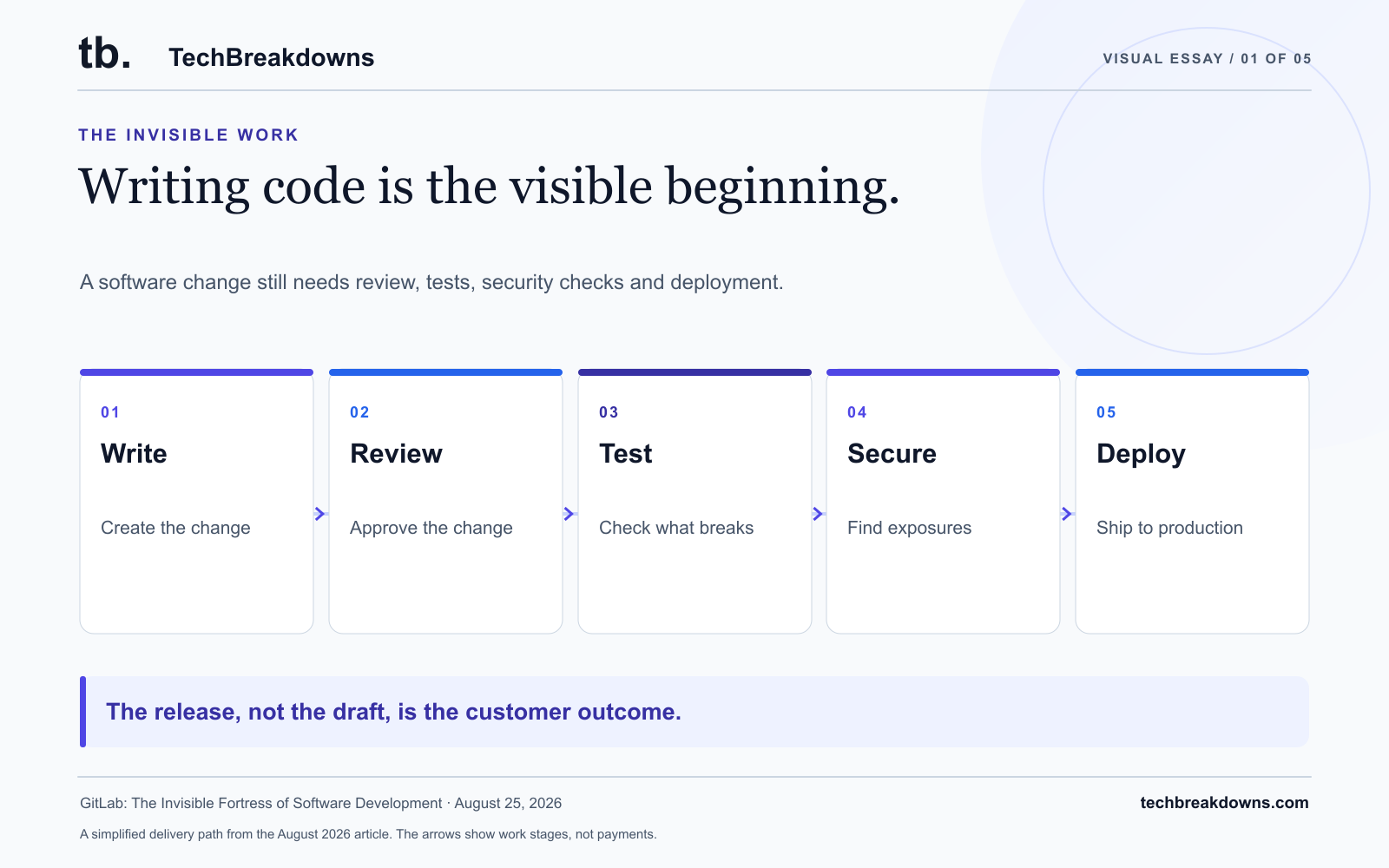
THE INVISIBLE WORK
Writing code is the visible beginning.
A software change still needs review, tests, security checks and deployment. GitLab sells a shared platform for those less visible steps.
A simplified delivery path from the August 2026 article. The arrows show work stages, not payments.
GitLab: The Invisible Fortress of Software Development · August 25, 2026
 Enlarge graphic
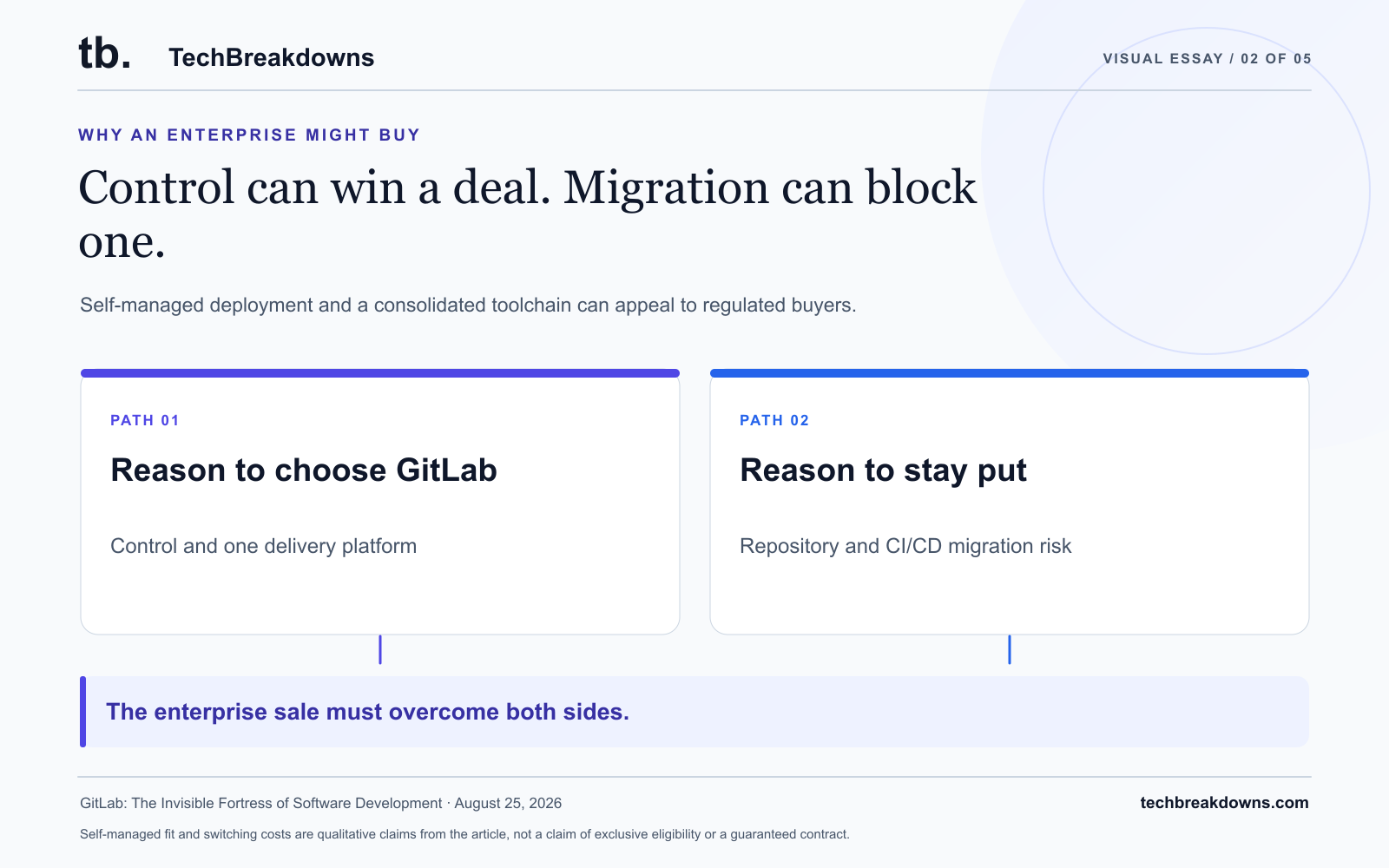
WHY AN ENTERPRISE MIGHT BUY
Control can win a deal. Migration can block one.
Self-managed deployment and a consolidated toolchain can appeal to regulated buyers. Moving code and pipelines from an incumbent is itself risky and costly.
Self-managed fit and switching costs are qualitative claims from the article, not a claim of exclusive eligibility or a guaranteed contract.
GitLab: The Invisible Fortress of Software Development · August 25, 2026
 Enlarge graphic
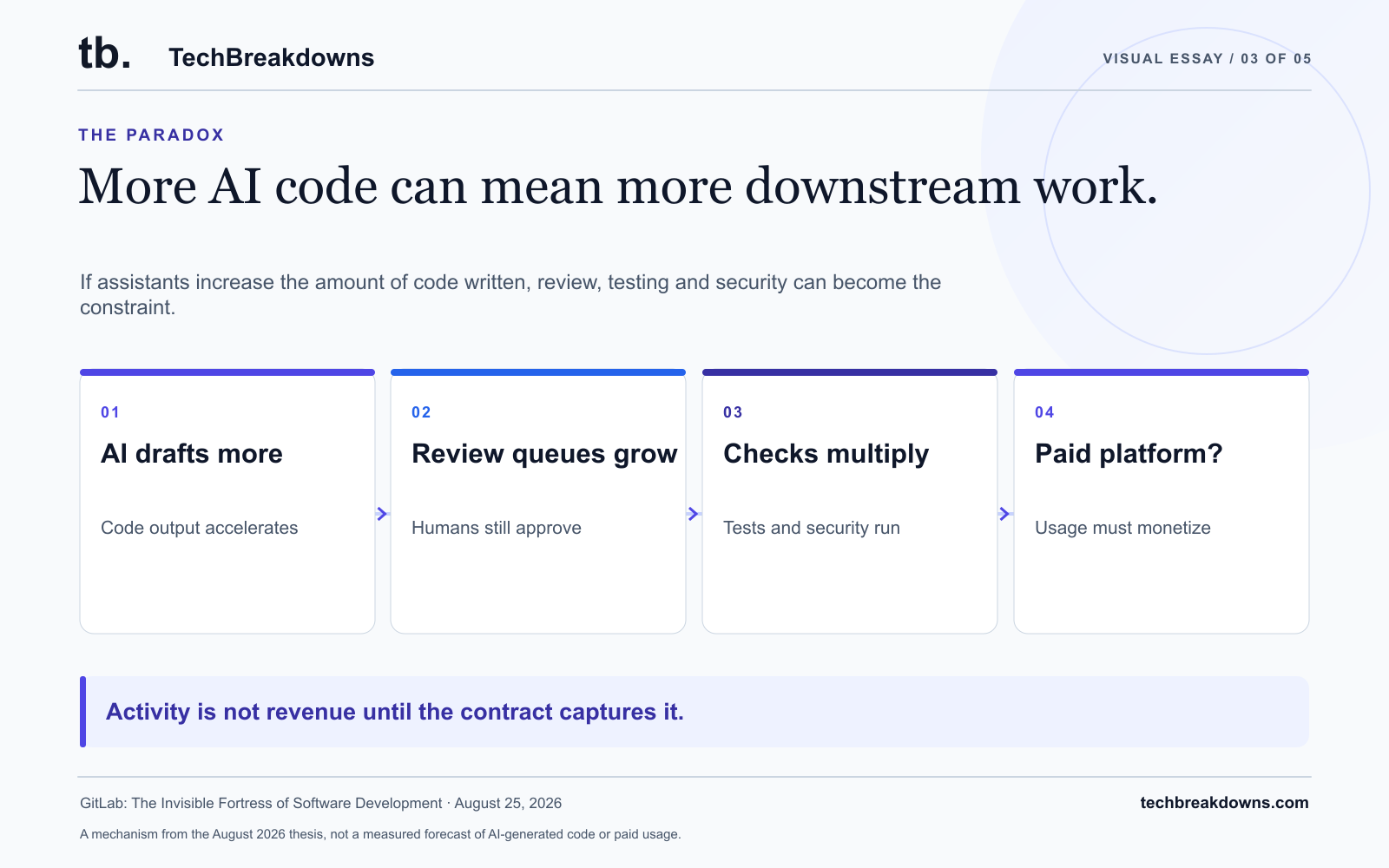
THE PARADOX
More AI code can mean more downstream work.
If assistants increase the amount of code written, review, testing and security can become the constraint. GitLab benefits only if customers pay it to handle that work.
A mechanism from the August 2026 thesis, not a measured forecast of AI-generated code or paid usage.
GitLab: The Invisible Fortress of Software Development · August 25, 2026
 Enlarge graphic
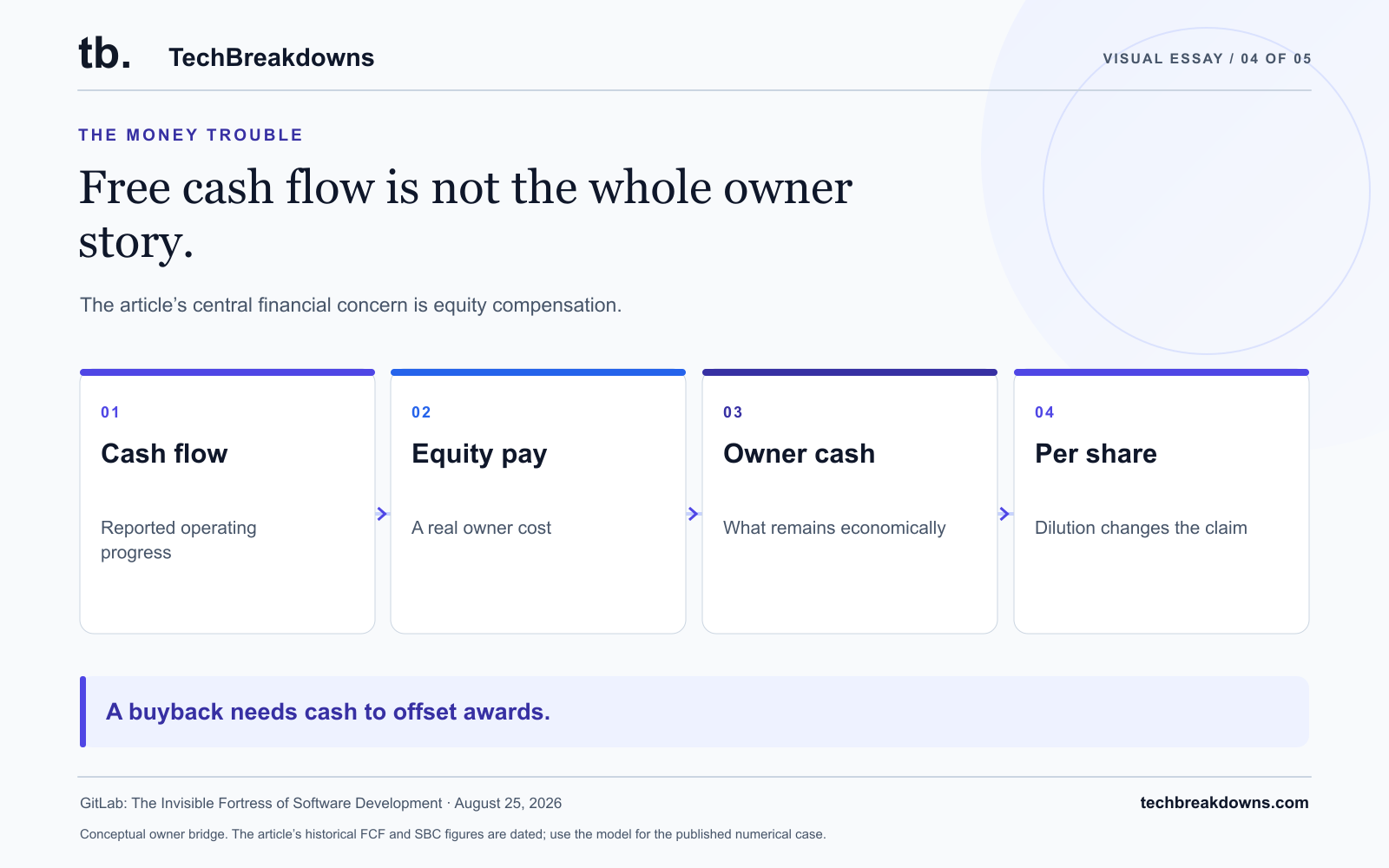
THE MONEY TROUBLE
Free cash flow is not the whole owner story.
The article’s central financial concern is equity compensation. Cash generation must be weighed against awards and future dilution before valuing each share.
Conceptual owner bridge. The article’s historical FCF and SBC figures are dated; use the model for the published numerical case.
GitLab: The Invisible Fortress of Software Development · August 25, 2026
 Enlarge graphic
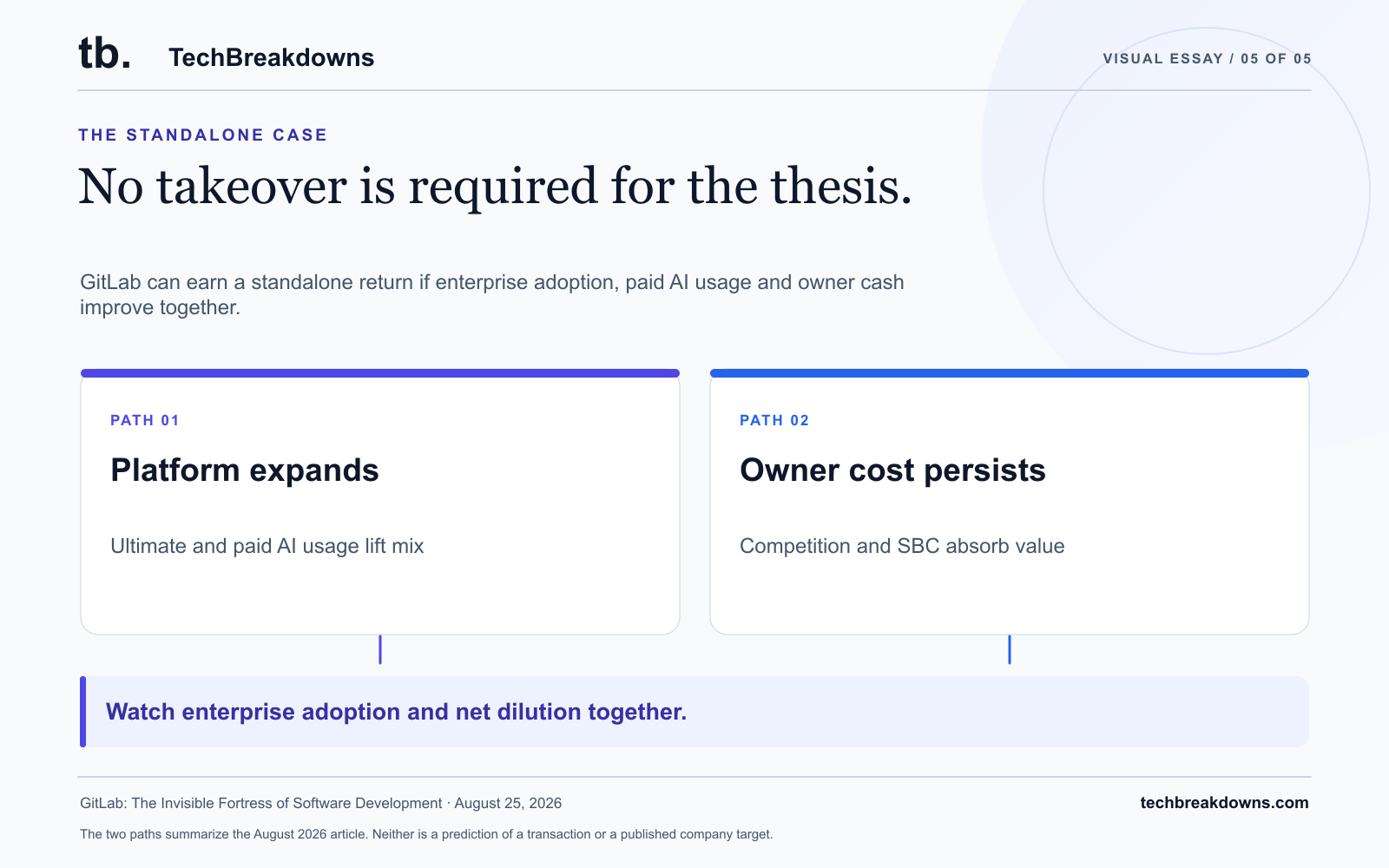
THE STANDALONE CASE
No takeover is required for the thesis.
GitLab can earn a standalone return if enterprise adoption, paid AI usage and owner cash improve together. A buyout is an optional possibility, not the base case.
The two paths summarize the August 2026 article. Neither is a prediction of a transaction or a published company target.
GitLab: The Invisible Fortress of Software Development · August 25, 2026
The thesis in a minute
THE OVERVIEW
First, understand
the business.
The idea, the advantage,
and the question that matters.
An AI agent can write the change. Someone still has to review it, test it, secure it and ship it. GitLab's opportunity is to turn those less visible jobs into a more valuable platform as software activity grows.
What it does
GitLab brings source code, review, testing, security and delivery into a shared software platform. Enterprises pay for subscriptions and additional capabilities. The model separates core subscriptions, Ultimate and incremental AI usage to explore how a richer mix might change growth and cash generation.
Why it might win
The pitch is consolidation: teams can manage more of the software lifecycle with one platform. Self-managed deployment offers another reason some enterprises choose GitLab. Existing workflows also create switching costs, which protect incumbents and make winning a new customer harder.
What could break
More code does not automatically mean more GitLab revenue. Microsoft competes through GitHub, customers resist migration, and AI activity must become paid use. Even a successful platform leaves less for owners if employee equity compensation remains expensive.
01 / THE STORY
Follow the business before the stock.
As AI makes code easier to write, can GitLab earn more from getting that code safely into production?

The bottleneck moves downstream
The bull thesis starts after code is written. If more software creates more review, testing and security work, the platform coordinating that work can become more valuable. That demand still needs monetization.

One platform is a difficult sale
Replacing several tools can simplify a customer's stack, but moving repositories and pipelines creates risk. GitLab must make the gain worth the disruption while competing with GitHub's reach.

The last claim belongs to owners
Cash generation is only part of the story. The model issues compensation shares and funds repurchases from cash. Better operating margins and a smaller equity-pay burden both matter to value per share.
Who pays, and why?
Developers
Use the platform to plan, write, review and ship software.
Enterprises
Pay for controls, security and coordination across teams.
AI users
May pay for Duo and usage-based capabilities when they improve work.
Find the revenue engine.
Each business has a different path from customer activity to value per share. These are the levers used in the model.

Premium & core
The underlying development workflow has to win and retain teams.

Ultimate
Enterprise security and governance can lift the value of one platform.

Duo & usage
AI features need paid adoption that reaches revenue rather than only attention.

Cash after equity pay
Revenue must become cash after employee awards; funded repurchases affect the share count.
These offerings map to model buckets. Future AI usage, margins and stock compensation are scenarios. See dated sources
THE OWNERSHIP STORY
Follow the share count.
A business can grow.
Your share of it can change, too.
MODELED SHARES OUTSTANDING
DO THE BUYBACKS ADD VALUE?
Same business assumptions. The no-buyback case keeps the unspent cash.
Test the buyback assumptions
THE BUSINESS
How the story becomes a business.
Handle the work after code
Review, testing, security and delivery turn software changes into production releases.
Win a bigger platform role
Enterprise adoption and paid AI use drive recurring revenue and the product mix.
Leave more for owners
Cash conversion, compensation dilution and funded repurchases shape the value of each share.
Loading reported business flow…
THE VALUATION MODEL
One business.
Three possible futures.
The business is the same. The assumptions change.
Choose a case, then make it your own.
Each number is a modeled ending, not a reported result.
What needs to happen?
Change the main drivers here. Then view the money flow or open the full model below.
Explore the other businesses
Give each business its own growth and cash margin. Every change flows into this same scenario.
Reference price —
SEE THE MODEL IN MOTION
See where the money goes.
The sliders above shape one scenario. Follow its annual money flow below, then open the full inputs if you want to go deeper.
Open the interactive diagramMove through the modeled years
Follow the money, year by year.
Each ribbon uses the same dollar scale across this scenario. Move through the modeled years to see what changes.
Swipe sideways to follow the full flow →
This diagram traces annual revenue into cash and owner economics; ribbons do not represent payments between these businesses.
Advanced assumptions and annual tableAdjust the full model and inspect each year
THE THESIS TEST
What to watch for?
- 01
The enterprise sale works
Track customer expansion, retention and Ultimate adoption. Consolidation needs to show up in recurring revenue.
- 02
AI becomes paid work
Look for incremental AI and usage revenue, not just activity or product demonstrations.
- 03
Owners keep more
Watch cash margins, compensation as a share of revenue and net dilution together. Buybacks alone may not reduce the share count.
IN THE TECHBREAKDOWNS SYSTEM
Where GitLab sits.
Follow GitLab into the market it serves, the indices that track its stage, and the model portfolios that hold it.
Reinvestors
Held since Aug 12, 2026: +21.3% from its logged entry price through Oct 1, 2026. It passes the current screen.