Nu Holdings
A better bank can still be an expensive stock.
Nu makes banking easier and cheaper to operate. Shareholder returns still depend on credit quality, profitable expansion and the price placed on future earnings.
In the systemIssuers & creditReinvestors portfolioWhere it sits ↓
Model updated on
THE STORY IN PICTURES
A better bank still has to earn its price.
Start with the customer, then follow credit risk and the earnings multiple.
 Enlarge graphic
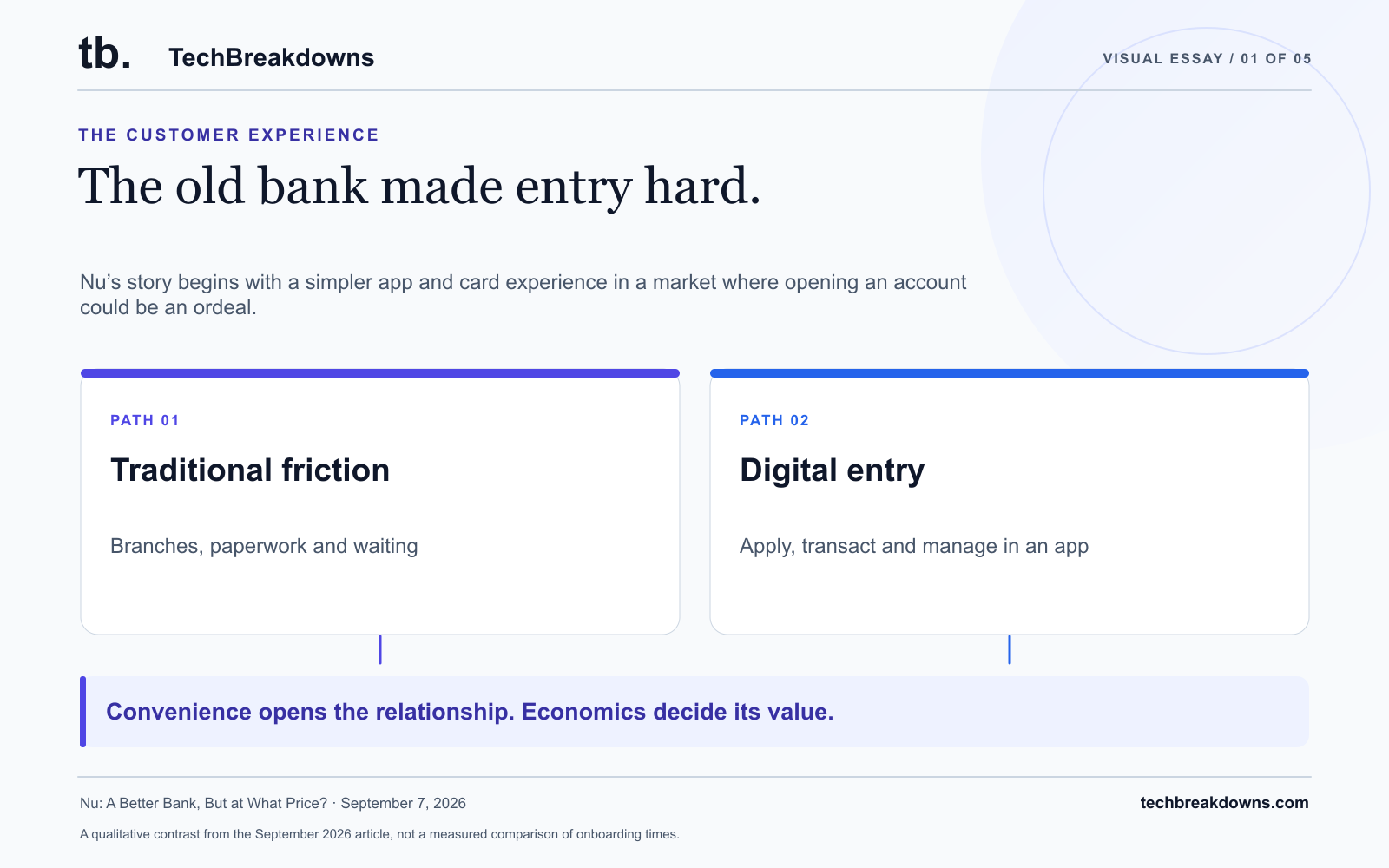
THE CUSTOMER EXPERIENCE
The old bank made entry hard.
Nu’s story begins with a simpler app and card experience in a market where opening an account could be an ordeal. Winning the customer starts the relationship.
A qualitative contrast from the September 2026 article, not a measured comparison of onboarding times.
 Enlarge graphic
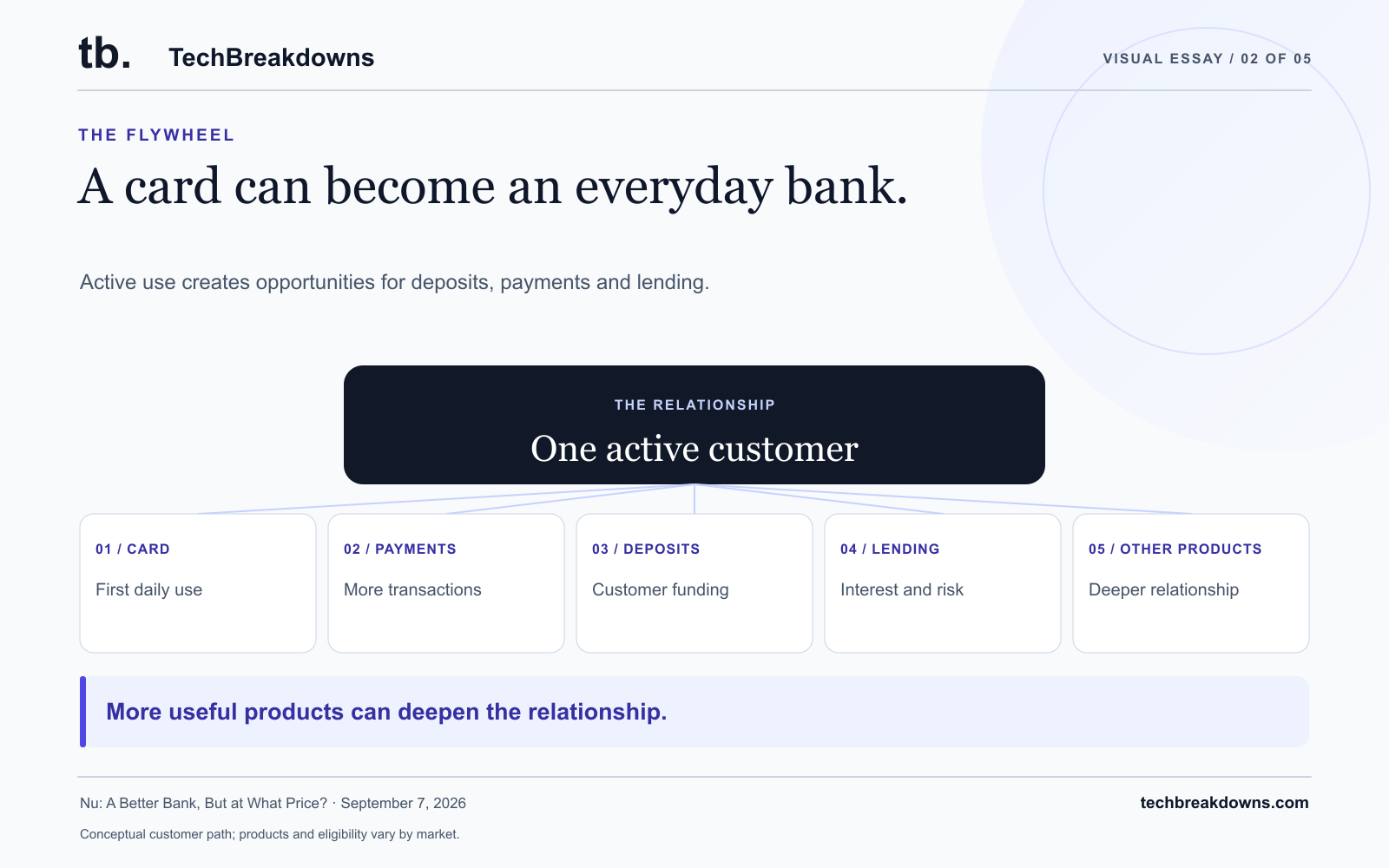
THE FLYWHEEL
A card can become an everyday bank.
Active use creates opportunities for deposits, payments and lending. More products may raise revenue per customer, but a larger customer count alone is not profit.
Conceptual customer path; products and eligibility vary by market.
 Enlarge graphic
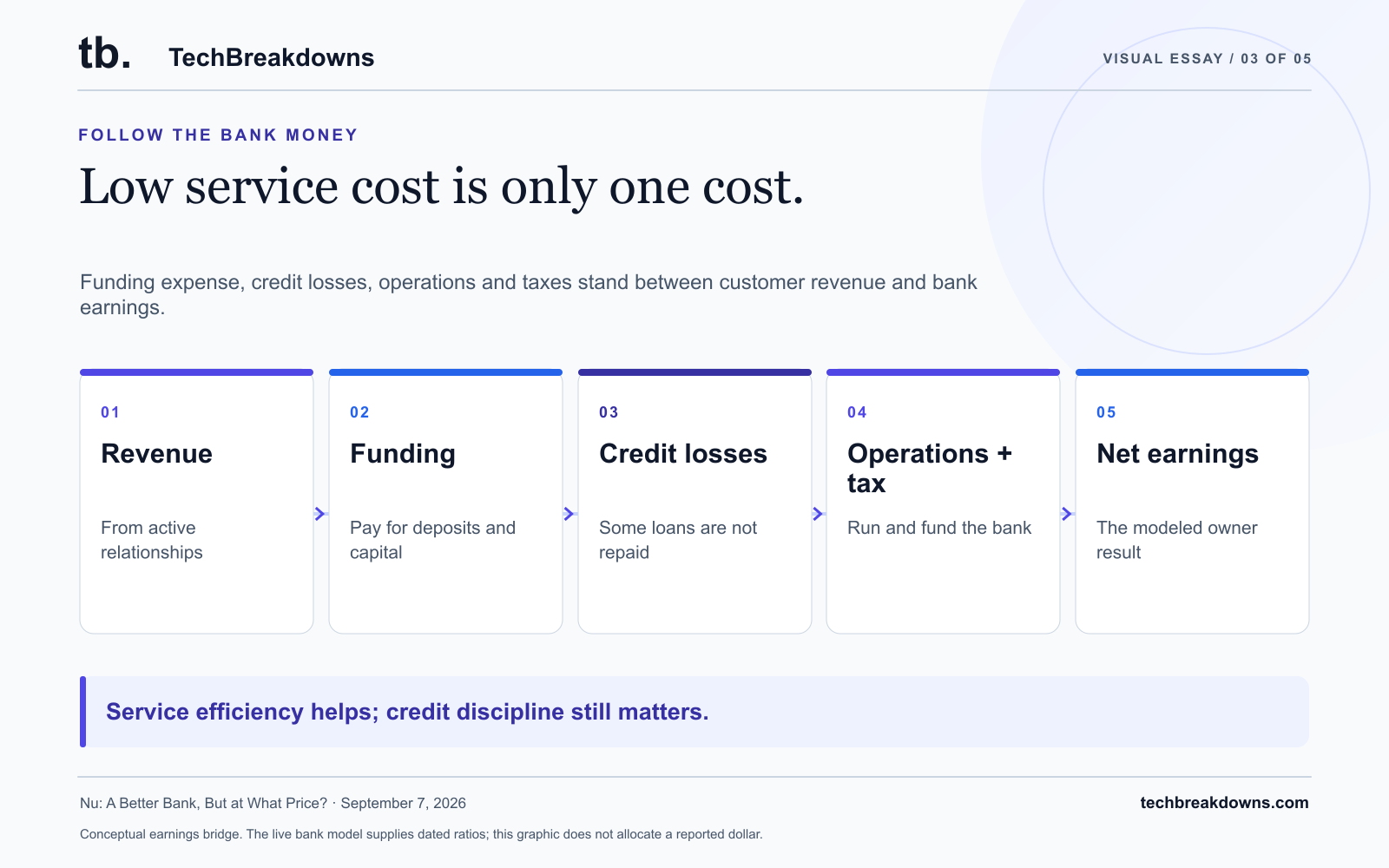
FOLLOW THE BANK MONEY
Low service cost is only one cost.
Funding expense, credit losses, operations and taxes stand between customer revenue and bank earnings. Deposits and loan balances are not free cash flow.
Conceptual earnings bridge. The live bank model supplies dated ratios; this graphic does not allocate a reported dollar.
 Enlarge graphic
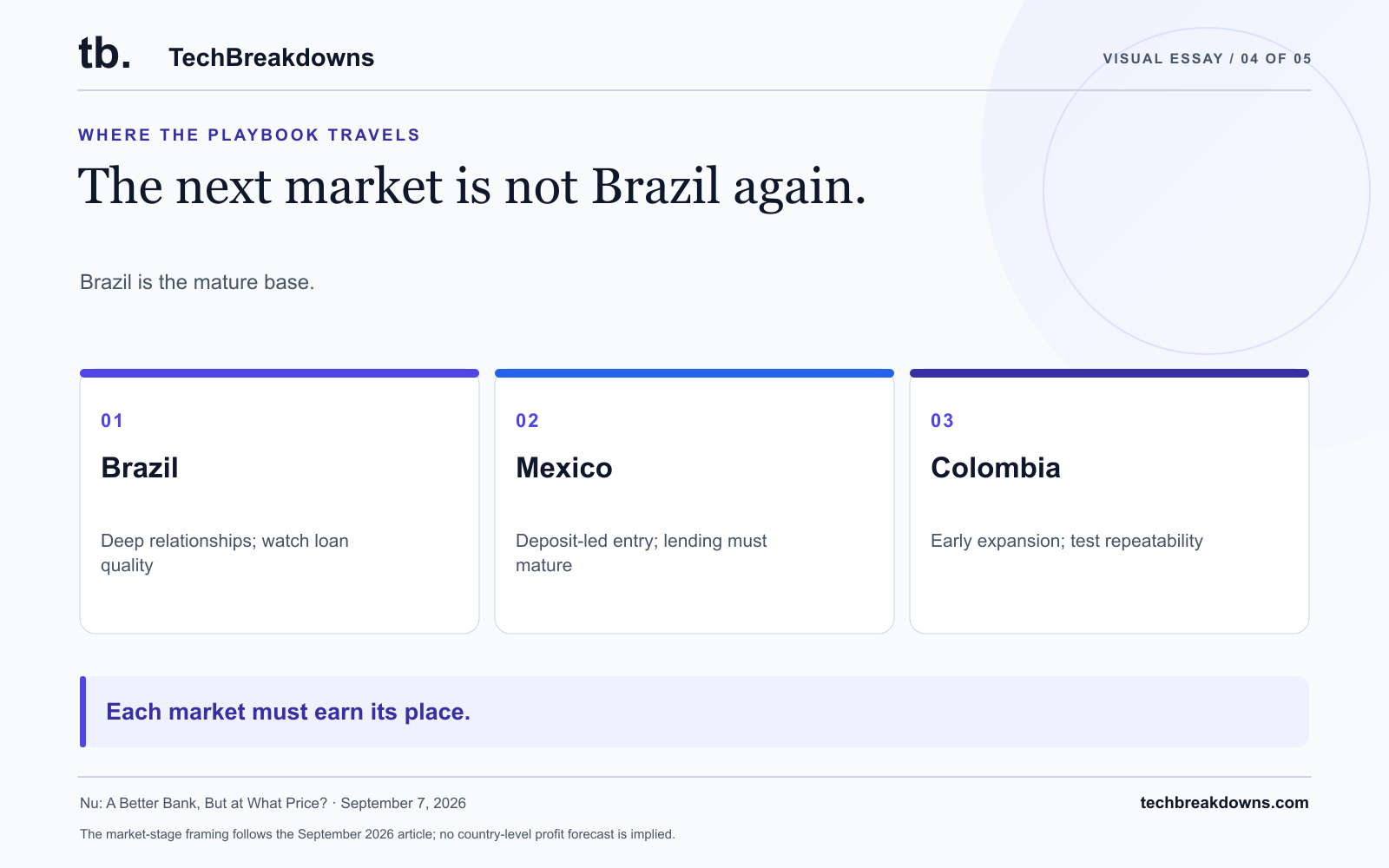
WHERE THE PLAYBOOK TRAVELS
The next market is not Brazil again.
Brazil is the mature base. Mexico and Colombia are earlier chapters where deposits, lending and credit quality must prove their own economics.
The market-stage framing follows the September 2026 article; no country-level profit forecast is implied.
 Enlarge graphic
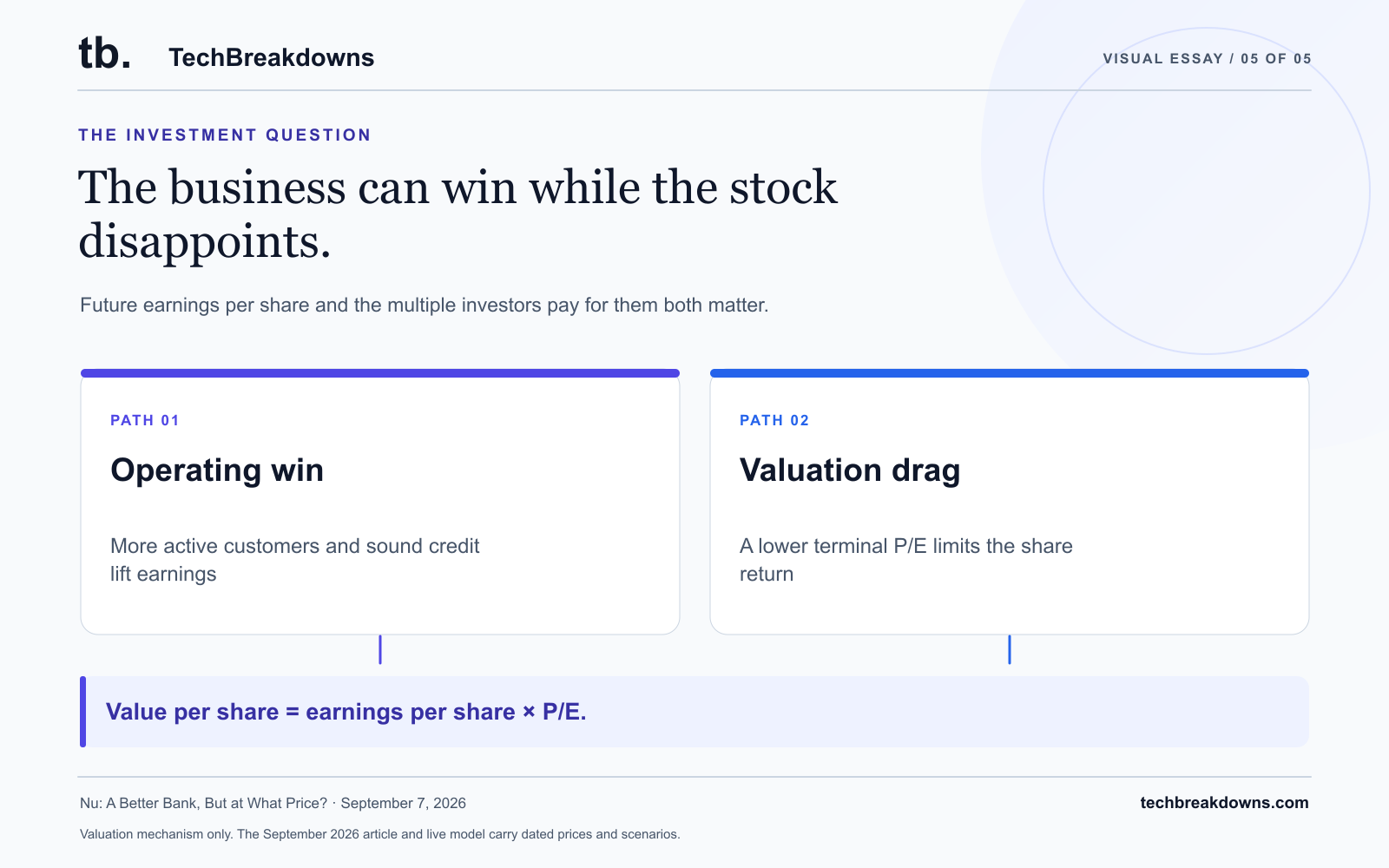
THE INVESTMENT QUESTION
The business can win while the stock disappoints.
Future earnings per share and the multiple investors pay for them both matter. A lower bank-like P/E can erase some operating progress.
Valuation mechanism only. The September 2026 article and live model carry dated prices and scenarios.
The thesis in a minute
THE OVERVIEW
First, understand
the business.
The idea, the advantage,
and the question that matters.
Opening a bank account should not feel like an obstacle course. Nu built its appeal around a simpler experience. Winning the customer is the first chapter. Keeping that relationship profitable through lending cycles and new markets is the investment story.
What it does
Nu offers digital banking, cards and other financial products in Brazil, Mexico and Colombia. More active customers and more revenue per customer grow the business. Funding costs, credit losses, operating expenses and taxes determine how much of that revenue becomes profit.
Why it might win
A branchless service and efficient technology can lower the cost of serving customers. As people adopt more products, revenue can grow faster than servicing costs. That is an operating advantage to test; it does not remove the costs or capital requirements of banking.
What could break
Nu can become a much bigger, more profitable bank while delivering a modest stock return if investors award it a lower earnings multiple. New markets must produce durable customer economics, and credit quality must hold as lending expands.
01 / THE STORY
Follow the business before the stock.
Can Nu deepen the banking relationship without giving back the gain to credit losses or an expensive entry price?

A better experience opens the door
Nu's founding story starts with frustration at traditional banking. An app and a simpler product can attract customers, but popularity has to turn into active financial relationships.

The relationship deepens
Cards, deposits and additional products create more ways to earn revenue. Growing credit limits also puts more money at risk. The quality of those relationships matters as much as their number.

The multiple gets a vote
The scenarios value earnings per share at a future bank multiple. A lower multiple can absorb much of the operating progress. Deposits and accumulated profits are not added again as free shareholder cash.
Who pays, and why?
Account holders
Use digital accounts, deposits and payments as everyday banking tools.
Borrowers
Use cards and loans; credit quality determines what lending earns.
Investors
Value future earnings per share, subject to capital needs and the price multiple.
Find the revenue engine.
Each business has a different path from customer activity to value per share. These are the levers used in the model.

Accounts and deposits
A useful low-friction account gives customers a reason to become active.

Cards, payments and services
More use can raise revenue per active customer.

Lending
Loan growth must clear funding costs and credit losses.

Value per share
Earnings, shares and the eventual multiple set the modeled ending.
This is a bank earnings model. It does not treat deposits or loan balances as free cash flow. See dated sources
THE BUSINESS
How the story becomes a business.
Become the everyday bank
Customer growth, active use and additional products expand the revenue opportunity.
Keep the lending profitable
Funding costs and credit losses must leave healthy earnings after operating expenses and tax.
Price those earnings
Earnings per share and the future P/E multiple jointly determine the modeled share value.
Loading reported business flow…
THE VALUATION MODEL
One business.
Three possible futures.
The business is the same. The assumptions change.
Choose a case, then make it your own.
Each number is a modeled ending, not a reported result.
What needs to happen?
Change the main drivers here. Then view the money flow or open the full model below.
Explore the other businesses
Give each business its own growth and cash margin. Every change flows into this same scenario.
Reference price —
SEE THE MODEL IN MOTION
See where the money goes.
The sliders above shape one scenario. Follow its annual money flow below, then open the full inputs if you want to go deeper.
Open the interactive diagramMove through the modeled years
Follow the money, year by year.
Each ribbon uses the same dollar scale across this scenario. Move through the modeled years to see what changes.
Swipe sideways to follow the full flow →
This diagram traces annual revenue into cash and owner economics; ribbons do not represent payments between these businesses.
Advanced assumptions and annual tableAdjust the full model and inspect each year
THE THESIS TEST
What to watch for?
- 01
Active, valuable relationships
Follow activity and revenue per active customer alongside account growth. A large customer count is only the starting point.
- 02
The cost of credit and deposits
Track delinquency, provisioning and funding costs together. Low servicing expense is not the full cost of a bank.
- 03
New markets earn their place
Look for deposit retention and sustainable profit in Mexico and Colombia as introductory economics mature.
IN THE TECHBREAKDOWNS SYSTEM
Where Nu Holdings sits.
Follow Nu Holdings into the market it serves, the indices that track its stage, and the model portfolios that hold it.
Issuers & credit
Digital banking, card issuing and lending through Nubank
Also at this stage JPMorgan Chase, Bank of America, Citigroup, Synchrony, Capital One, American Express and 2 more.
Index member
Nu Holdings is 0.53% of the cap-weight index and 1.60% of the equal-weight index, as of Oct 6, 2026.
Reinvestors
Held since Sep 1, 2026: −12.7% from its logged entry price through Oct 1, 2026. It passes the current screen.